
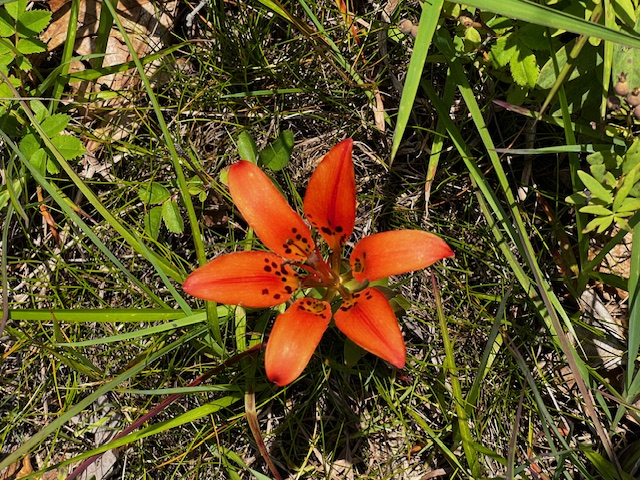
Among the notable findings, the list highlights the rediscovery of the wood lily (Lilium philadelphicum) in Allegany County after 118 years. Photo by by R.H. Wiegand
The Maryland Department of Natural Resources (DNR) released its updated 2026 Rare, Threatened, and Endangered (RTE) Plants of Maryland list, an important resource reflecting significant conservation efforts by the department’s Wildlife and Heritage Service.
This document, available in list-only and expanded versions, is a vital resource for botanists, researchers, naturalists, and plant enthusiasts. It contains a unique assemblage of global and local conservation rankings, historical records, natural histories, and local knowledge of all plant species known in our state. The 2026 update incorporates extensive work and hundreds of edits to species information, reflecting the most current understanding of Maryland’s plant populations.
“The level of detail in this update is testament to our ongoing commitment to preserving Maryland’s natural heritage,” said Christopher Frye, state botanist for the Wildlife and Heritage Service and staff lead on this project.
Key highlights of the 2026 updates include:
- Taxonomic and Status Revisions: The list features 28 taxonomic changes and 44 revisions to species conservation rank or status.
- Distribution and Phenology Data: DNR botanists completed 89 amendments to county and/or physiographic province distributions and added 12 updated flowering/fruiting dates.
- New Species: Eight new species were included in the list.
- Documentation: Fifteen new references were added based on vetted historical Maryland collections and documents.
Among the notable findings, the list highlights the rediscovery of the wood lily (Lilium philadelphicum) in Allegany County after 118 years. Additionally, two globally critically imperilled (G1) species that have been recently described through scientific research have been added to the list: Atlantic ladies tresses (Spiranthes bightensis) and Mid-Atlantic beaksedge (Rhynchospora mesoatlantica).
The discovery of the Mid-Atlantic beaksedge is a story that spans decades and crosses state lines. In the mid 1980s while walking through the wetlands of the Eastern Shore, two botanists, William McAvoy and Frank Hirst, discovered an unfamiliar sedge – a grasslike plant often known for triangular stems. One of them concluded it was Harper’s beaksedge (Rhynchospora harperi) and the observation was recorded.
By 2023, the field of genetics had advanced by leaps and bounds. Amanda Eberly, a botanist for NatureServe and graduate student at the New York Botanical Garden, worked with noted botanist Robert Naczi to a write paper describing a new species: the Mid-Atlantic beaksedge. It was then discovered that the Eastern Shore species found in the 1980s was actually this new species. This finding makes this sedge a globally rare species that is only known to exist in three places on Earth – New Jersey, Delaware, and Maryland.
Native plants play a crucial role in supporting the ecosystems we rely on in Maryland, providing everything from the oxygen we breathe to host plants for insects that pollinate our food crops. Plants are also deeply tied to Maryland’s history and culture, and they play a role in our future too. Extinction of just one plant species could mean the loss of a potential disease cure or biomedical discovery, highlighting the importance of preserving them.
The updated RTE Plant List is now available on the Maryland DNR website.
